
Calcium Grease Formulation
Calcium Grease: General Overview, Composition and Formulation
Calcium grease is a water-resistant lubricating grease normally produced by thickening a selected base oil with calcium soap. It is commonly developed for chassis, agricultural machinery, plain bearings, water pumps and general industrial equipment operating at moderate temperatures.
The formulation is not selected from one fixed recipe. Base-oil viscosity, thickener concentration, water balance and additives are adjusted according to the required NLGI grade, dropping point, texture, colour, load, speed and operating environment.
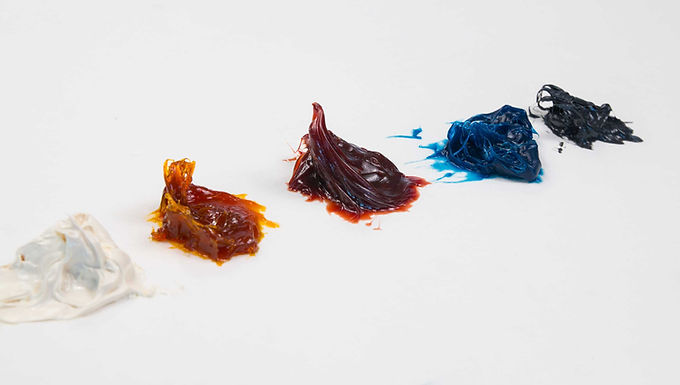
Available development options include smooth or fibrous texture, natural or coloured grease, red gel calcium grease, translucent grades and NLGI 0, 1, 2 or 3 products.
General Composition of Calcium Grease
- COMPONENT | PURPOSE
Base oil
Mineral or selected specialty oil providing the main lubricating film.
Calcium thickener system
Calcium soap formed from suitable fatty material and calcium hydroxide; provides grease structure and water resistance.
Controlled water
Supports the structure of conventional hydrated calcium grease and requires careful process control.
Antioxidant
Helps reduce oxidation of the base oil during storage and service.
Rust and corrosion inhibitor
Protects lubricated metal surfaces in humid or wet conditions.
Antiwear or EP additive
Added when the target application requires improved wear or load-carrying performance.
Tackifier or polymer
Used where stronger adhesion, stringiness or resistance to wash-off is required.
Dye or appearance modifier
Used for red, coloured, translucent or customer-specific appearance.
The final percentages depend on raw materials, NLGI grade, equipment and validated performance targets.
Production Process and Lubechem Technical Support
- TYPICAL MANUFACTURING SEQUENCE
1. Charge the selected portion of base oil into the grease reactor.
2. Prepare and control the calcium soap-forming reaction.
3. Maintain the required temperature, water balance, mixing and reaction time.
4. Add finishing oil progressively to develop the target consistency.
5. Cool the batch under controlled agitation.
6. Add heat-sensitive additives, dye and performance components at suitable temperatures.
7. Homogenise or mill the grease to achieve a uniform, smooth texture.
8. Deaerate, filter where required, test and release the finished batch.
LUBECHEM CONSULTANT SUPPORT
• Raw-material selection and alternative sourcing
• Complete formulation and composition documentation
• Manufacturing SOP and batch sheet
• Video-guided laboratory trials
• NLGI-grade and performance optimisation
• Pilot-batch and commercial scale-up
• Plant design, equipment selection and pilot-plant supply
• Operator training and first-production support
• Troubleshooting of soft, hard, grainy, bleeding or unstable grease
Typical Specifications, Testing and Applications
- TYPICAL DEVELOPMENT TARGETS
NLGI grade: 0, 1, 2 or 3
Worked penetration: ASTM D217
Dropping point: commonly around 85–110°C for conventional hydrated calcium systems
Water washout: ASTM D1264 or application-specific testing
Corrosion protection: ASTM D1743 or equivalent
Oil separation: ASTM D1742 or equivalent
Mechanical stability: worked-penetration change
Appearance: smooth and homogeneous; natural, red, coloured or translucent
COMMON APPLICATIONS
• Automotive and commercial-vehicle chassis points
• Agricultural and construction machinery
• Plain bearings and low-to-moderate-speed components
• Water pumps and wet operating environments
• Conveyors and general industrial equipment
These values are general development targets. Final specifications must be established through testing of the approved formulation and production batch.
Calcium Grease Formulation: Frequently Asked Questions
- Can one calcium grease formulation be used in every plant?
No. Reactor design, heating method, agitation, raw materials, batch size and finishing equipment affect the process and final grease.
Can Lubechem develop red gel or translucent calcium grease?
Yes. Colour, transparency, texture and consistency can be developed alongside technical performance.
Which NLGI grades can be developed?
Calcium grease can be formulated in NLGI 0, 1, 2 and 3 grades according to the application.
What documentation is provided?
The agreed project can include composition sheets, raw-material details, SOP, batch sheet, test plan and quality-control limits.
Is support available during manufacturing?
Yes. We provide video-guided lab trials, pilot-scale support, commercial-batch supervision and production troubleshooting.
Are the listed specifications guaranteed?
No universal grease specification should be guaranteed without testing. Final claims are established after laboratory and production validation.
Get in Touch with Us
If you found this information useful and would like to discuss further, please contact us. We are committed to providing high-quality solutions tailored to your specific needs.